Debug your models efficiently
This tutorial gives insights on how you can debug tespy models. The user interface of the current implementation might still need some refinement, so you are invited to raise issues in the github repository. We will change it based on the feedback. The outputs shown here are based on the following version of tespy:
from tespy import __version__
__version__
"0.11.0 - Rankine's Renaissance"
Simple model debugging
This tutorial will show a couple of things
How to extract the variables of the problem
before presolving step
after presolving step and identify the presolved variables
How to extract the applied equations of the problem
before presolving step
after presolving step and identify the presolved equations
How to read and fix the errors that are raised during presolving
How to debug structural errors and non-convergence with the structural analysis, the incidence matrix and the residuals
Model overview
The model we implement is a very simple heat pump model, just as implemented in the introductory Heat Pump tutorial.
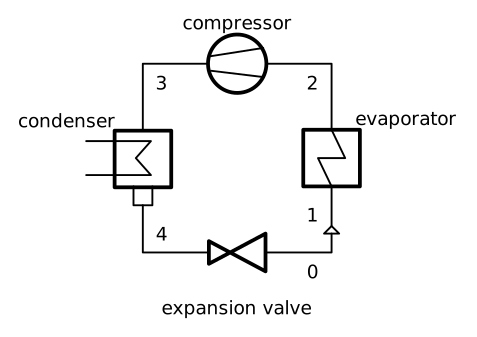

Model code
from tespy.components import CycleCloser, SimpleHeatExchanger, Compressor, Valve, Motor, PowerSource
from tespy.connections import Connection, PowerConnection
from tespy.networks import Network
nw = Network()
nw.units.set_defaults(
    temperature="°C",
    pressure="bar",
    pressure_difference="bar",
    power="kW",
    heat="kW",
    enthalpy="kJ/kg"
)
grid = PowerSource("grid")
motor = Motor("motor")

cc = CycleCloser("cycle closer")
valve = Valve("valve")
evaporator = SimpleHeatExchanger("evaporator")
compressor = Compressor("compressor")
condenser = SimpleHeatExchanger("condenser")

c1 = Connection(cc, "out1", evaporator, "in1", label="c1")
c2 = Connection(evaporator, "out1", compressor, "in1", label="c2")
c3 = Connection(compressor, "out1", condenser, "in1", label="c3")
c4 = Connection(condenser, "out1", valve, "in1", label="c4")
c0 = Connection(valve, "out1", cc, "in1", label="c0")


nw.add_conns(c1, c2, c3, c4, c0)

e1 = PowerConnection(grid, "power", motor, "power_in", label="e1")
e2 = PowerConnection(motor, "power_out", compressor, "power", label="e2")

nw.add_conns(e1, e2)
Debug the model
Variable and equation identification
With nothing specified and trying to solve we will get an information, that the network is lacking fluid information.
nw.solve("design", init_only=True)
---------------------------------------------------------------------------
TESPyNetworkError                         Traceback (most recent call last)
Cell In[5], line 1
----> 1 nw.solve("design", init_only=True)

File ~/checkouts/readthedocs.org/user_builds/tespy/envs/1031/lib/python3.14/site-packages/tespy/networks/network.py:2545, in Network.solve(self, mode, init_path, design_path, max_iter, min_iter, init_only, init_previous, use_cuda, print_results, robust_relax, skip_postprocess, oscillation_damping, block_solve, pause_on_block_failure)
   2449 def solve(self, mode, init_path=None, design_path=None,
   2450           max_iter=50, min_iter=2, init_only=False, init_previous=True,
   2451           use_cuda=False, print_results=True, robust_relax=False, skip_postprocess=False,
   2452           oscillation_damping=False, block_solve=True,
   2453           pause_on_block_failure=False):
   2454     r"""
   2455     Solve the network.
   2456
   (...)   2543     documentation at tespy.readthedocs.io in the section "TESPy modules".
   2544     """
-> 2545     self.presolve(
   2546         mode, init_path=init_path, design_path=design_path,
   2547         init_previous=init_previous, check=not init_only
   2548     )
   2550     if init_only:
   2551         return

File ~/checkouts/readthedocs.org/user_builds/tespy/envs/1031/lib/python3.14/site-packages/tespy/networks/network.py:2638, in Network.presolve(self, mode, init_path, design_path, init_previous, check)
   2631 msg = (
   2632     "Network information:\n"
   2633     f" - Number of components: {len(self.comps)}\n"
   2634     f" - Number of connections: {len(self.conns)}\n"
   2635 )
   2636 logger.debug(msg)
-> 2638 self._prepare_problem()
   2639 self._presolve_pending = True
   2641 if not check:

File ~/checkouts/readthedocs.org/user_builds/tespy/envs/1031/lib/python3.14/site-packages/tespy/networks/network.py:1006, in Network._prepare_problem(self)
   1003         self._create_fluid_wrapper_branches()
   1004         break
-> 1006 self._propagate_fluid_wrappers()
   1007 self._init_connection_result_datastructure()
   1009 self._prepare_solve_mode()

File ~/checkouts/readthedocs.org/user_builds/tespy/envs/1031/lib/python3.14/site-packages/tespy/networks/network.py:1090, in Network._propagate_fluid_wrappers(self)
   1084 if num_potential_fluids == 0:
   1085     msg = (
   1086         "The following connections of your network are missing any "
   1087         "kind of fluid composition information:"
   1088         f"{', '.join([c.label for c in all_connections])}."
   1089     )
-> 1090     raise hlp.TESPyNetworkError(msg)
   1092 for c in all_connections:
   1093     c.mixing_rule = mixing_rule

TESPyNetworkError: The following connections of your network are missing any kind of fluid composition information:c1, c2, c3, c4, c0.
Then let’s specify the fluid and preprocess the network again. The check,
whether the number of specified parameters matches the number of variables of
the problem, runs automatically at the start of every solve. When running with
init_only=True the check is skipped and no error is raised, so we can use
that starting point in an interactive python environment to get started with
debugging.
c1.set_attr(fluid={"R290": 1})
nw.solve("design", init_only=True)
Now we can check the following information:
Which are the original variables of our model
Which of those variables have already been determined by the presolving
Which ones are the actual variables, that the model has to solve and which original variables of the model these variables represent
The original variables:
nw.print_variables_before_presolve()
Variables before presolving (22 total):
Object    Property
--------  ----------
c0        m
c0        p
c0        h
c0        fluid
c1        m
c1        p
c1        h
c1        fluid
c2        m
c2        p
c2        h
c2        fluid
c3        m
c3        p
c3        h
c3        fluid
c4        m
c4        p
c4        h
c4        fluid
e1        E
e2        E
The variables solved already by the presolving step:
nw.print_presolved_variables()
Presolved variables (5 total):
Object    Property
--------  ----------
c0        fluid
c1        fluid
c2        fluid
c3        fluid
c4        fluid
The actual variables of the problem: each has a number and a property type
(mass flow, pressure, enthalpy, fluid, …) and represents one or more of the
original variables. The represents column lists those with the label of the
connection they originate from.
nw.print_variables()
Variables after presolving (10 total):
  #  Property    Represents
---  ----------  --------------------------------------
  0  p           c2 (p)
  1  h           c2 (h)
  2  p           c3 (p)
  3  h           c3 (h)
  4  p           c4 (p)
  5  E           e1 (E)
  6  E           e2 (E)
  7  m           c2 (m), c3 (m), c1 (m), c4 (m), c0 (m)
  8  p           c0 (p), c1 (p)
  9  h           c0 (h), c1 (h), c4 (h)
We can also check which equations of the model have been presolved in order to
retrieve the dependencies between the variables. E.g. the mass flow variable
just before represents all the mass flows in this model. We can see, that the
mass_flow_constraints have been solved for all components. The equations
indicated here can be inspected in the tables of the documentation on the
components and
connections.
nw.print_presolved_equations()
Presolved equations (11 total):
Object        Equation
------------  ----------------------------
compressor    mass_flow_constraints
compressor    fluid_constraints
condenser     mass_flow_constraints
condenser     fluid_constraints
cycle closer  pressure_equality_constraint
cycle closer  enthalpy_equality_constraint
evaporator    mass_flow_constraints
evaporator    fluid_constraints
valve         mass_flow_constraints
valve         fluid_constraints
valve         enthalpy_constraints
There is not yet an easy way to identify which variable was presolved by which. Next to the presolved equations we can also inspect, which equations are present in the actual model that needs to be solved iteratively.
nw.print_equations()
Equations after presolving (1 total):
  Eq#  Object      Equation
-----  ----------  ------------------------
    0  compressor  energy_connector_balance
With the equations we can also extract the variables these depend on.
nw.print_equations_with_dependents()
Equations with dependent variables (1 total):
  Eq#  Object      Equation                  Dependent variables
-----  ----------  ------------------------  ---------------------
    0  compressor  energy_connector_balance  h1, h3, E6, m7
Impose parameters and check again
Now let’s impose a couple of boundary conditions:
No pressure drop in heat exchanges
Compressor efficiency
Motor efficiency
condenser.set_attr(dp=0)
evaporator.set_attr(dp=0)
compressor.set_attr(eta_s=0.8)
motor.set_attr(eta=0.97)
nw.solve("design", init_only=True)
Again, we can inspect, which variables have been presolved now. It does not change, because we did not impose any boundary conditions, where any of the variables can be directly determined from.
nw.print_presolved_variables()
Presolved variables (5 total):
Object    Property
--------  ----------
c0        fluid
c1        fluid
c2        fluid
c3        fluid
c4        fluid
But if we check the actual variables of the system, we see that the number has been reduced. The two energy flows are now mapped to a single variable, and the pressure values before and after the heat exchangers have been also mapped to a single variable respectively.
nw.print_variables()
Variables after presolving (7 total):
  #  Property    Represents
---  ----------  --------------------------------------
  0  h           c2 (h)
  1  h           c3 (h)
  2  m           c2 (m), c3 (m), c1 (m), c4 (m), c0 (m)
  3  p           c3 (p), c4 (p)
  4  p           c0 (p), c1 (p), c2 (p)
  5  h           c0 (h), c1 (h), c4 (h)
  6  E           e1 (E), e2 (E)
The reason for that can be seen in the presolved equations, where now we have three additional entries.
nw.print_presolved_equations()
Presolved equations (14 total):
Object        Equation
------------  ----------------------------
compressor    mass_flow_constraints
compressor    fluid_constraints
condenser     mass_flow_constraints
condenser     fluid_constraints
condenser     dp
cycle closer  pressure_equality_constraint
cycle closer  enthalpy_equality_constraint
evaporator    mass_flow_constraints
evaporator    fluid_constraints
evaporator    dp
motor         eta
valve         mass_flow_constraints
valve         fluid_constraints
valve         enthalpy_constraints
And we also get one more equation in our model equations, that needs to be solved numerically: the compressor efficiency.
nw.print_equations_with_dependents()
Equations with dependent variables (2 total):
  Eq#  Object      Equation                  Dependent variables
-----  ----------  ------------------------  ---------------------
    0  compressor  energy_connector_balance  h0, h1, m2, E6
    1  compressor  eta_s                     h0, h1, p3, p4
Or in a matrix view:
nw.print_incidence_matrix()
Incidence matrix:
                                     h0    h1    m2    p3    p4    E6
-----------------------------------  ----  ----  ----  ----  ----  ----
compressor.energy_connector_balance  x     x     x     -     -     x
compressor.eta_s                     x     x     -     x     x     -
Let’s add more boundary conditions, because we are still missing a couple:
evaporation temperature level and superheating
c2.set_attr(T_dew=10, td_dew=10)
nw.solve("design", init_only=True)
Now we can see that the number of variables has been reduced by two. The reason for this is, that the presolver was able to identify pressure and enthalpy at the compressor inlet with the given boundary conditions.
nw.print_variables()
Variables after presolving (5 total):
  #  Property    Represents
---  ----------  --------------------------------------
  0  h           c3 (h)
  1  m           c2 (m), c3 (m), c1 (m), c4 (m), c0 (m)
  2  p           c3 (p), c4 (p)
  3  h           c0 (h), c1 (h), c4 (h)
  4  E           e1 (E), e2 (E)
Since these two variables have now been presolved, the equation of the compressor has less dependents, as it is not necessary to solve for the respective variables anymore.
nw.print_equations_with_dependents()
Equations with dependent variables (2 total):
  Eq#  Object      Equation                  Dependent variables
-----  ----------  ------------------------  ---------------------
    0  compressor  energy_connector_balance  h0, m1, E4
    1  compressor  eta_s                     h0, p2
We are still missing 3 equations as we have 5 variables in the problem and only 2 equations at the moment, so let’s add the missing specifications:
electrical power input
condensing temperature level and subcooling
c4.set_attr(T_bubble=60, td_bubble=0)
e1.set_attr(E=100)  # 100 kW
nw.solve("design")
 block   0 | scalar          | iterations:   2 | residual: 0.00e+00 | compressor.eta_s
 block   1 | scalar          | iterations:   2 | residual: 2.15e-15 | compressor.energy_connector_balance
The solver output shows that the two remaining equations were solved as individual blocks in sequence. The block decomposition can be inspected directly, see the decomposition section for the background:
nw.print_blocks()
Block lower triangular decomposition (2 blocks):
  #  Kind      Needs  Equations                            Variables
---  ------  -------  -----------------------------------  -----------
  0  scalar           compressor.eta_s                     h0
  1  scalar        0  compressor.energy_connector_balance  m1
nw.print_incidence_matrix(block_order=True)
Incidence matrix:
  Block                                       h0    m1
-------  -----------------------------------  ----  ----
      0  compressor.eta_s                     X     -
      1  compressor.energy_connector_balance  x     X
Handle errors during presolving
Some errors can occur during presolving, for example:
You specify a linear change of specific variable while specifying both values simultaneously. In this case, the error message directly tells you which variables are linear dependent and that you specified more than a single value in that set (points to the labels of the connections/components).
e2.set_attr(E=97)
nw.solve("design")
---------------------------------------------------------------------------
TESPyNetworkError                         Traceback (most recent call last)
Cell In[26], line 2
      1 e2.set_attr(E=97)
----> 2 nw.solve("design")

File ~/checkouts/readthedocs.org/user_builds/tespy/envs/1031/lib/python3.14/site-packages/tespy/networks/network.py:2545, in Network.solve(self, mode, init_path, design_path, max_iter, min_iter, init_only, init_previous, use_cuda, print_results, robust_relax, skip_postprocess, oscillation_damping, block_solve, pause_on_block_failure)
   2449 def solve(self, mode, init_path=None, design_path=None,
   2450           max_iter=50, min_iter=2, init_only=False, init_previous=True,
   2451           use_cuda=False, print_results=True, robust_relax=False, skip_postprocess=False,
   2452           oscillation_damping=False, block_solve=True,
   2453           pause_on_block_failure=False):
   2454     r"""
   2455     Solve the network.
   2456
   (...)   2543     documentation at tespy.readthedocs.io in the section "TESPy modules".
   2544     """
-> 2545     self.presolve(
   2546         mode, init_path=init_path, design_path=design_path,
   2547         init_previous=init_previous, check=not init_only
   2548     )
   2550     if init_only:
   2551         return

File ~/checkouts/readthedocs.org/user_builds/tespy/envs/1031/lib/python3.14/site-packages/tespy/networks/network.py:2638, in Network.presolve(self, mode, init_path, design_path, init_previous, check)
   2631 msg = (
   2632     "Network information:\n"
   2633     f" - Number of components: {len(self.comps)}\n"
   2634     f" - Number of connections: {len(self.conns)}\n"
   2635 )
   2636 logger.debug(msg)
-> 2638 self._prepare_problem()
   2639 self._presolve_pending = True
   2641 if not check:

File ~/checkouts/readthedocs.org/user_builds/tespy/envs/1031/lib/python3.14/site-packages/tespy/networks/network.py:1014, in Network._prepare_problem(self)
   1010 # this method will distribute units and set SI values from given values
   1011 # and units
   1012 self._transform_user_input_to_SI()
-> 1014 self._problem.build()
   1016 # generic fluid property initialisation
   1017 self._set_starting_values()

File ~/checkouts/readthedocs.org/user_builds/tespy/envs/1031/lib/python3.14/site-packages/tespy/solver/problem.py:188, in Problem.build(self)
    181 msg = (
    182     f"Original problem: {self.num_original_variables} variables and "
    183     f"{self.num_original_equations} equations, of which {num_affine} "
    184     "equations were consumed by the affine variable elimination."
    185 )
    186 logger.debug(msg)
--> 188 self._presolve()
    190 # counted only now: during the structure matrix assembly the
    191 # specification and variable flags of the containers are transient,
    192 # e.g. propagated fluid compositions read as set while their
    193 # variable fractions are only marked during the presolving
    194 self.num_specified_variables = 0

File ~/checkouts/readthedocs.org/user_builds/tespy/envs/1031/lib/python3.14/site-packages/tespy/solver/problem.py:495, in Problem._presolve(self)
    491 self._presolve_fluid_vectors()
    493 # impose the user specifications on the affine groups first, so the
    494 # first round of connection presolving already sees them as known
--> 495 self._presolve_linear_dependents()
    497 # only scalar references are tracked: the fluid vectors were
    498 # fully resolved above and their is_var holds a set of fraction
    499 # names, not a boolean
    500 known_references = set()

File ~/checkouts/readthedocs.org/user_builds/tespy/envs/1031/lib/python3.14/site-packages/tespy/solver/problem.py:703, in Problem._presolve_linear_dependents(self)
    697     var_str = ", ".join(variables_properties)
    698     msg = (
    699         "You specified more than one variable within a set of "
    700         "linearly dependent variables.\n"
    701         f"  Variables:  {var_str}"
    702     )
--> 703     raise hlp.TESPyNetworkError(msg)
    704 elif number_specifications == 1:
    705     reference_data = self._variable_lookup[reference]

TESPyNetworkError: You specified more than one variable within a set of linearly dependent variables.
  Variables:  e1 (E), e2 (E)
We can see the same problem if we were to specify compressor pressure ratio: The compressor inlet pressure is determined from the compressor inlet state, the condenser outlet pressure is determined from the condenser outlet state and the condenser pressure drop is specified. By that also the compressor outlet pressure is known and you cannot specify the outlet pressure.
e2.set_attr(E=None)
compressor.set_attr(pr=4)
nw.solve("design", init_only=True)
---------------------------------------------------------------------------
TESPyNetworkError                         Traceback (most recent call last)
Cell In[27], line 3
      1 e2.set_attr(E=None)
      2 compressor.set_attr(pr=4)
----> 3 nw.solve("design", init_only=True)

File ~/checkouts/readthedocs.org/user_builds/tespy/envs/1031/lib/python3.14/site-packages/tespy/networks/network.py:2545, in Network.solve(self, mode, init_path, design_path, max_iter, min_iter, init_only, init_previous, use_cuda, print_results, robust_relax, skip_postprocess, oscillation_damping, block_solve, pause_on_block_failure)
   2449 def solve(self, mode, init_path=None, design_path=None,
   2450           max_iter=50, min_iter=2, init_only=False, init_previous=True,
   2451           use_cuda=False, print_results=True, robust_relax=False, skip_postprocess=False,
   2452           oscillation_damping=False, block_solve=True,
   2453           pause_on_block_failure=False):
   2454     r"""
   2455     Solve the network.
   2456
   (...)   2543     documentation at tespy.readthedocs.io in the section "TESPy modules".
   2544     """
-> 2545     self.presolve(
   2546         mode, init_path=init_path, design_path=design_path,
   2547         init_previous=init_previous, check=not init_only
   2548     )
   2550     if init_only:
   2551         return

File ~/checkouts/readthedocs.org/user_builds/tespy/envs/1031/lib/python3.14/site-packages/tespy/networks/network.py:2638, in Network.presolve(self, mode, init_path, design_path, init_previous, check)
   2631 msg = (
   2632     "Network information:\n"
   2633     f" - Number of components: {len(self.comps)}\n"
   2634     f" - Number of connections: {len(self.conns)}\n"
   2635 )
   2636 logger.debug(msg)
-> 2638 self._prepare_problem()
   2639 self._presolve_pending = True
   2641 if not check:

File ~/checkouts/readthedocs.org/user_builds/tespy/envs/1031/lib/python3.14/site-packages/tespy/networks/network.py:1014, in Network._prepare_problem(self)
   1010 # this method will distribute units and set SI values from given values
   1011 # and units
   1012 self._transform_user_input_to_SI()
-> 1014 self._problem.build()
   1016 # generic fluid property initialisation
   1017 self._set_starting_values()

File ~/checkouts/readthedocs.org/user_builds/tespy/envs/1031/lib/python3.14/site-packages/tespy/solver/problem.py:188, in Problem.build(self)
    181 msg = (
    182     f"Original problem: {self.num_original_variables} variables and "
    183     f"{self.num_original_equations} equations, of which {num_affine} "
    184     "equations were consumed by the affine variable elimination."
    185 )
    186 logger.debug(msg)
--> 188 self._presolve()
    190 # counted only now: during the structure matrix assembly the
    191 # specification and variable flags of the containers are transient,
    192 # e.g. propagated fluid compositions read as set while their
    193 # variable fractions are only marked during the presolving
    194 self.num_specified_variables = 0

File ~/checkouts/readthedocs.org/user_builds/tespy/envs/1031/lib/python3.14/site-packages/tespy/solver/problem.py:519, in Problem._presolve(self)
    517 for c in to_check:
    518     self._presolved_equations += c._presolve()
--> 519 self._presolve_linear_dependents()
    521 newly_known = []
    522 for linear_dependents in self._variable_dependencies:

File ~/checkouts/readthedocs.org/user_builds/tespy/envs/1031/lib/python3.14/site-packages/tespy/solver/problem.py:703, in Problem._presolve_linear_dependents(self)
    697     var_str = ", ".join(variables_properties)
    698     msg = (
    699         "You specified more than one variable within a set of "
    700         "linearly dependent variables.\n"
    701         f"  Variables:  {var_str}"
    702     )
--> 703     raise hlp.TESPyNetworkError(msg)
    704 elif number_specifications == 1:
    705     reference_data = self._variable_lookup[reference]

TESPyNetworkError: You specified more than one variable within a set of linearly dependent variables.
  Variables:  c2 (p), c3 (p), c1 (p), c0 (p), c4 (p)
You can also think of creating a circular dependency. For example, if you specify a relationship of mass flow in front and behind the cycle closer (or if you were to remove the cycle closer). Then the mass flow would form a circular dependency. As output of the error message you get the variables which are part of the circular dependency and the equations responsible for that.
compressor.set_attr(pr=None)


from tespy.connections import Ref

c1.set_attr(m=Ref(c0, 1, 0))
nw.solve("design", init_only=True)
---------------------------------------------------------------------------
TESPyNetworkError                         Traceback (most recent call last)
Cell In[28], line 7
      3
      4 from tespy.connections import Ref
      5
      6 c1.set_attr(m=Ref(c0, 1, 0))
----> 7 nw.solve("design", init_only=True)

File ~/checkouts/readthedocs.org/user_builds/tespy/envs/1031/lib/python3.14/site-packages/tespy/networks/network.py:2545, in Network.solve(self, mode, init_path, design_path, max_iter, min_iter, init_only, init_previous, use_cuda, print_results, robust_relax, skip_postprocess, oscillation_damping, block_solve, pause_on_block_failure)
   2449 def solve(self, mode, init_path=None, design_path=None,
   2450           max_iter=50, min_iter=2, init_only=False, init_previous=True,
   2451           use_cuda=False, print_results=True, robust_relax=False, skip_postprocess=False,
   2452           oscillation_damping=False, block_solve=True,
   2453           pause_on_block_failure=False):
   2454     r"""
   2455     Solve the network.
   2456
   (...)   2543     documentation at tespy.readthedocs.io in the section "TESPy modules".
   2544     """
-> 2545     self.presolve(
   2546         mode, init_path=init_path, design_path=design_path,
   2547         init_previous=init_previous, check=not init_only
   2548     )
   2550     if init_only:
   2551         return

File ~/checkouts/readthedocs.org/user_builds/tespy/envs/1031/lib/python3.14/site-packages/tespy/networks/network.py:2638, in Network.presolve(self, mode, init_path, design_path, init_previous, check)
   2631 msg = (
   2632     "Network information:\n"
   2633     f" - Number of components: {len(self.comps)}\n"
   2634     f" - Number of connections: {len(self.conns)}\n"
   2635 )
   2636 logger.debug(msg)
-> 2638 self._prepare_problem()
   2639 self._presolve_pending = True
   2641 if not check:

File ~/checkouts/readthedocs.org/user_builds/tespy/envs/1031/lib/python3.14/site-packages/tespy/networks/network.py:1014, in Network._prepare_problem(self)
   1010 # this method will distribute units and set SI values from given values
   1011 # and units
   1012 self._transform_user_input_to_SI()
-> 1014 self._problem.build()
   1016 # generic fluid property initialisation
   1017 self._set_starting_values()

File ~/checkouts/readthedocs.org/user_builds/tespy/envs/1031/lib/python3.14/site-packages/tespy/solver/problem.py:176, in Problem.build(self)
    167 def build(self):
    168     """Construct the problem from the prepared network.
    169
    170     - Assemble the structure matrix and the structure graph and reduce the
   (...)    174       incidence.
    175     """
--> 176     self._create_structure_matrix()
    178     self.num_original_variables = len(self._variable_lookup)
    179     self.num_original_equations = len(self._equation_set_lookup)

File ~/checkouts/readthedocs.org/user_builds/tespy/envs/1031/lib/python3.14/site-packages/tespy/solver/problem.py:260, in Problem._create_structure_matrix(self)
    252 sum_eq = self._preprocess_network_parts(self.network.user_defined_eq.values(), sum_eq)
    254 self.structure_graph = StructureGraph(
    255     self._structure_matrix, self._rhs,
    256     self._variable_lookup, self._equation_set_lookup,
    257     self._equation_set_origin
    258 )
    259 _linear_dependencies = (
--> 260     self.structure_graph.find_linear_dependent_variables()
    261 )
    262 _linear_dependent_variables = [
    263     var for linear_dependents in _linear_dependencies
    264     for var in linear_dependents["variables"]
    265 ]
    266 # variables without any affine partner become singleton groups
    267 # referencing themselves: every variable owns a reference
    268 # container this way and no consumer has to distinguish grouped
    269 # from ungrouped variables

File ~/checkouts/readthedocs.org/user_builds/tespy/envs/1031/lib/python3.14/site-packages/tespy/solver/structure.py:198, in StructureGraph.find_linear_dependent_variables(self)
    196 cycle = self.find_cycle()
    197 if cycle is not None:
--> 198     self.raise_error_if_cycle(cycle)
    200 adjacency_list = self.affine_adjacency
    201 eq_idx = self.edge_eq_idx

File ~/checkouts/readthedocs.org/user_builds/tespy/envs/1031/lib/python3.14/site-packages/tespy/solver/structure.py:180, in StructureGraph.raise_error_if_cycle(self, cycle)
    174 eq_str = ", ".join(f"{lbl}.{eq}" for lbl, eq in equations)
    175 msg = (
    176     "A circular dependency has been detected. This overdetermines the problem.\n"
    177     f"  Variables:  {var_str}\n"
    178     f"  Equations:  {eq_str}"
    179 )
--> 180 raise hlp.TESPyNetworkError(msg)

TESPyNetworkError: A circular dependency has been detected. This overdetermines the problem.
  Variables:  c0 (m), c1 (m), c2 (m), c3 (m), c4 (m)
  Equations:  c1.m_ref, compressor.mass_flow_constraints, condenser.mass_flow_constraints, evaporator.mass_flow_constraints, valve.mass_flow_constraints
A last error that might occur is specification of properties that determine the same variable, e.g. the c2 pressure as the evaporation pressure is already determined from the saturation temperature and superheating.
c1.set_attr(m=None)
c2.set_attr(p=10)  # p has already been set!
nw.solve("design")
---------------------------------------------------------------------------
TESPyNetworkError                         Traceback (most recent call last)
Cell In[29], line 3
      1 c1.set_attr(m=None)
      2 c2.set_attr(p=10)  # p has already been set!
----> 3 nw.solve("design")

File ~/checkouts/readthedocs.org/user_builds/tespy/envs/1031/lib/python3.14/site-packages/tespy/networks/network.py:2545, in Network.solve(self, mode, init_path, design_path, max_iter, min_iter, init_only, init_previous, use_cuda, print_results, robust_relax, skip_postprocess, oscillation_damping, block_solve, pause_on_block_failure)
   2449 def solve(self, mode, init_path=None, design_path=None,
   2450           max_iter=50, min_iter=2, init_only=False, init_previous=True,
   2451           use_cuda=False, print_results=True, robust_relax=False, skip_postprocess=False,
   2452           oscillation_damping=False, block_solve=True,
   2453           pause_on_block_failure=False):
   2454     r"""
   2455     Solve the network.
   2456
   (...)   2543     documentation at tespy.readthedocs.io in the section "TESPy modules".
   2544     """
-> 2545     self.presolve(
   2546         mode, init_path=init_path, design_path=design_path,
   2547         init_previous=init_previous, check=not init_only
   2548     )
   2550     if init_only:
   2551         return

File ~/checkouts/readthedocs.org/user_builds/tespy/envs/1031/lib/python3.14/site-packages/tespy/networks/network.py:2638, in Network.presolve(self, mode, init_path, design_path, init_previous, check)
   2631 msg = (
   2632     "Network information:\n"
   2633     f" - Number of components: {len(self.comps)}\n"
   2634     f" - Number of connections: {len(self.conns)}\n"
   2635 )
   2636 logger.debug(msg)
-> 2638 self._prepare_problem()
   2639 self._presolve_pending = True
   2641 if not check:

File ~/checkouts/readthedocs.org/user_builds/tespy/envs/1031/lib/python3.14/site-packages/tespy/networks/network.py:1014, in Network._prepare_problem(self)
   1010 # this method will distribute units and set SI values from given values
   1011 # and units
   1012 self._transform_user_input_to_SI()
-> 1014 self._problem.build()
   1016 # generic fluid property initialisation
   1017 self._set_starting_values()

File ~/checkouts/readthedocs.org/user_builds/tespy/envs/1031/lib/python3.14/site-packages/tespy/solver/problem.py:188, in Problem.build(self)
    181 msg = (
    182     f"Original problem: {self.num_original_variables} variables and "
    183     f"{self.num_original_equations} equations, of which {num_affine} "
    184     "equations were consumed by the affine variable elimination."
    185 )
    186 logger.debug(msg)
--> 188 self._presolve()
    190 # counted only now: during the structure matrix assembly the
    191 # specification and variable flags of the containers are transient,
    192 # e.g. propagated fluid compositions read as set while their
    193 # variable fractions are only marked during the presolving
    194 self.num_specified_variables = 0

File ~/checkouts/readthedocs.org/user_builds/tespy/envs/1031/lib/python3.14/site-packages/tespy/solver/problem.py:518, in Problem._presolve(self)
    516 rounds += 1
    517 for c in to_check:
--> 518     self._presolved_equations += c._presolve()
    519 self._presolve_linear_dependents()
    521 newly_known = []

File ~/checkouts/readthedocs.org/user_builds/tespy/envs/1031/lib/python3.14/site-packages/tespy/connections/connection.py:1501, in Connection._presolve(self)
   1494 if num_specs > 2:
   1495     msg = (
   1496         "You have specified more than 2 parameters for the connection "
   1497         f"{self.label} with a known fluid composition: "
   1498         f"{', '.join(specifications)}. This overdetermines the state "
   1499         "of the fluid."
   1500     )
-> 1501     raise TESPyNetworkError(msg)
   1503 presolved_equations = []
   1505 if self.p.is_set:

TESPyNetworkError: You have specified more than 2 parameters for the connection c2 with a known fluid composition: p, T_dew, td_dew. This overdetermines the state of the fluid.
c2.set_attr(p=None)
Inspect reasons for linear dependency
You can also inspect the network after solve crashing. For this, we will construct a case where, we get this exact issue:
We fix heat output of condenser (having fixed motor electrical power already)
no specification of evaporator delta p
The block decomposition is able determine, that the problem is structurally singular.
condenser.set_attr(Q=-350)
evaporator.set_attr(dp=None)
nw.solve("design")
The problem is structurally singular, block-wise solving is not possible.
Structural analysis - the problem contains an under-determined part (1 variable constrained by 0 equations) and an over-determined part (3 equations competing for 2 variables).
Use nw.print_structural_analysis() for the affected equations and variables. If the structural defect stems from an incomplete dependency declaration of a custom equation, the simultaneous solution can still be attempted with nw.solve(mode, block_solve=False).
The solver reports that the problem is structurally singular although the parameter count matches. One part of the model is over-determined while another part is under-determined at the same time. The structural analysis prints both:
nw.print_structural_analysis()
Under-determined part - the following variables cannot be determined by the involved equations:
  Variables: p2
  Involved equations:
Over-determined part - the following equations compete for the involved variables:
  Equations: compressor.energy_connector_balance, compressor.eta_s, condenser.Q
  Involved variables: h0, m1
We can see the same looking at the actual variables and the equations associated with them separately:
nw.print_variables()
Variables after presolving (3 total):
  #  Property    Represents
---  ----------  --------------------------------------
  0  h           c3 (h)
  1  m           c2 (m), c3 (m), c1 (m), c4 (m), c0 (m)
  2  p           c0 (p), c1 (p)
The under-determined variable p2 represents the pressures around the
evaporator: with its pressure drop specification removed, no equation
determines that pressure level anymore, while the condenser heat transfer
competes with the compressor equations for enthalpy and mass flow.
nw.print_equations_with_dependents()
Equations with dependent variables (3 total):
  Eq#  Object      Equation                  Dependent variables
-----  ----------  ------------------------  ---------------------
    0  compressor  energy_connector_balance  h0, m1
    1  compressor  eta_s                     h0
    2  condenser   Q                         h0, m1
nw.print_incidence_matrix(block_order=True)
Incidence matrix:
  Block                                       p2    h0    m1
-------  -----------------------------------  ----  ----  ----
      1  compressor.energy_connector_balance  -     X     X
         compressor.eta_s                     -     X     -
         condenser.Q                          -     X     X
nw.print_blocks()
Block lower triangular decomposition (2 blocks):
  #  Kind             Needs    Equations                                                           Variables
---  ---------------  -------  ------------------------------------------------------------------  -----------
  0  underdetermined                                                                               p2
  1  overdetermined            compressor.energy_connector_balance, compressor.eta_s, condenser.Q  h0, m1
A specification can also be numerically impossible while being structurally perfectly sound. In that case the structural analysis cannot detect the issue. Just a normal HeatExchanger is sufficient to show this:
from tespy.components import Source, Sink, HeatExchanger


nw = Network()
nw.units.set_defaults(
    temperature="°C",
    pressure="bar",
    pressure_difference="bar"
)

so1 = Source("source 1")
so2 = Source("source 2")

si1 = Sink("sink 1")
si2 = Sink("sink 2")

heatex = HeatExchanger("heatexchanger")

c1 = Connection(so1, "out1", heatex, "in1", label="c1")
c2 = Connection(heatex, "out1", si1, "in1", label="c2")
d1 = Connection(so2, "out1", heatex, "in2", label="d1")
d2 = Connection(heatex, "out2", si2, "in1", label="d2")

nw.add_conns(c1, c2, d1, d2)
Now we could make a specification that is impossible but hard to catch as being a setup problem: We set a minimum terminal temperature difference of 25 K but at the same time fix the temperature at hot side outlet and cold side inlet (leading to a temperature difference of 20 K).
c1.set_attr(fluid={"air": 1}, T=200, p=1, m=5)
c2.set_attr(T=110)
d1.set_attr(fluid={"water": 1}, T=90, p=1)
heatex.set_attr(dp1=0, dp2=0, ttd_min=25)
nw.solve("design")
Block 0 did not converge, solving the remaining 2 blocks simultaneously.
  Cause: no acceptance within the iteration budget of 50 iterations, the last scaled residual is 5.00e+00
  Equations: heatexchanger.ttd_min
  Variables: h0
block 0 | scalar | iterations: 50 | residual: 5.00e+00 | heatexchanger.ttd_min
The remaining system did not converge either, restarting with the simultaneous solution of the full system from its initial state.
 block   0 | remainder       | iterations:  50 | residual: 5.00e+00 | 2 equations

 iter  | residual   | progress   | massflow   | pressure   | enthalpy   | fluid      | energy     | component
-------+------------+------------+------------+------------+------------+------------+------------+------------
 1     | 5.00e+00   | 0 %        | 4.57e+02   | 0.00e+00   | 5.00e+00   | 0.00e+00   | 0.00e+00   | 0.00e+00
 2     | 5.00e+00   | 0 %        | 4.60e+00   | 0.00e+00   | 5.00e+00   | 0.00e+00   | 0.00e+00   | 0.00e+00
 3     | 5.00e+00   | 0 %        | 2.36e+00   | 0.00e+00   | 5.00e+00   | 0.00e+00   | 0.00e+00   | 0.00e+00
 4     | 5.00e+00   | 0 %        | 2.37e+00   | 0.00e+00   | 5.00e+00   | 0.00e+00   | 0.00e+00   | 0.00e+00
 5     | 5.00e+00   | 0 %        | 2.40e+00   | 0.00e+00   | 5.00e+00   | 0.00e+00   | 0.00e+00   | 0.00e+00
 6     | 5.00e+00   | 0 %        | 2.42e+00   | 0.00e+00   | 5.00e+00   | 0.00e+00   | 0.00e+00   | 0.00e+00
 7     | 5.00e+00   | 0 %        | 2.45e+00   | 0.00e+00   | 5.00e+00   | 0.00e+00   | 0.00e+00   | 0.00e+00
 8     | 5.00e+00   | 0 %        | 2.47e+00   | 0.00e+00   | 5.00e+00   | 0.00e+00   | 0.00e+00   | 0.00e+00
 9     | 5.00e+00   | 0 %        | 2.50e+00   | 0.00e+00   | 5.00e+00   | 0.00e+00   | 0.00e+00   | 0.00e+00
 10    | 5.00e+00   | 0 %        | 2.52e+00   | 0.00e+00   | 5.00e+00   | 0.00e+00   | 0.00e+00   | 0.00e+00
 11    | 5.00e+00   | 0 %        | 2.55e+00   | 0.00e+00   | 5.00e+00   | 0.00e+00   | 0.00e+00   | 0.00e+00
 12    | 5.00e+00   | 0 %        | 2.58e+00   | 0.00e+00   | 5.00e+00   | 0.00e+00   | 0.00e+00   | 0.00e+00
 13    | 5.00e+00   | 0 %        | 2.61e+00   | 0.00e+00   | 5.00e+00   | 0.00e+00   | 0.00e+00   | 0.00e+00
 14    | 5.00e+00   | 0 %        | 2.63e+00   | 0.00e+00   | 5.00e+00   | 0.00e+00   | 0.00e+00   | 0.00e+00
 15    | 5.00e+00   | 0 %        | 2.66e+00   | 0.00e+00   | 5.00e+00   | 0.00e+00   | 0.00e+00   | 0.00e+00
 16    | 5.00e+00   | 0 %        | 2.69e+00   | 0.00e+00   | 5.00e+00   | 0.00e+00   | 0.00e+00   | 0.00e+00
 17    | 5.00e+00   | 0 %        | 2.72e+00   | 0.00e+00   | 5.00e+00   | 0.00e+00   | 0.00e+00   | 0.00e+00
 18    | 5.00e+00   | 0 %        | 2.75e+00   | 0.00e+00   | 5.00e+00   | 0.00e+00   | 0.00e+00   | 0.00e+00
 19    | 5.00e+00   | 0 %        | 2.78e+00   | 0.00e+00   | 5.00e+00   | 0.00e+00   | 0.00e+00   | 0.00e+00
 20    | 5.00e+00   | 0 %        | 2.81e+00   | 0.00e+00   | 5.00e+00   | 0.00e+00   | 0.00e+00   | 0.00e+00
 21    | 5.00e+00   | 0 %        | 2.84e+00   | 0.00e+00   | 5.00e+00   | 0.00e+00   | 0.00e+00   | 0.00e+00
 22    | 5.00e+00   | 0 %        | 2.88e+00   | 0.00e+00   | 5.00e+00   | 0.00e+00   | 0.00e+00   | 0.00e+00
 23    | 5.00e+00   | 0 %        | 2.91e+00   | 0.00e+00   | 5.00e+00   | 0.00e+00   | 0.00e+00   | 0.00e+00
 24    | 5.00e+00   | 0 %        | 2.94e+00   | 0.00e+00   | 5.00e+00   | 0.00e+00   | 0.00e+00   | 0.00e+00
 25    | 5.00e+00   | 0 %        | 2.97e+00   | 0.00e+00   | 5.00e+00   | 0.00e+00   | 0.00e+00   | 0.00e+00
 26    | 5.00e+00   | 0 %        | 3.01e+00   | 0.00e+00   | 5.00e+00   | 0.00e+00   | 0.00e+00   | 0.00e+00
 27    | 5.00e+00   | 0 %        | 3.04e+00   | 0.00e+00   | 5.00e+00   | 0.00e+00   | 0.00e+00   | 0.00e+00
 28    | 5.00e+00   | 0 %        | 3.08e+00   | 0.00e+00   | 5.00e+00   | 0.00e+00   | 0.00e+00   | 0.00e+00
 29    | 5.00e+00   | 0 %        | 3.11e+00   | 0.00e+00   | 5.00e+00   | 0.00e+00   | 0.00e+00   | 0.00e+00
The solver does not seem to make any progress, aborting calculation. Scaled residual value is 5.00e+00 (heatexchanger: ttd_min)
Possible reasons include:
 - fluid properties moving outside the valid range of the property database (consider adjusting p_range or h_range),
 - an impossible constraint that can never be satisfied
 - bad starting values causing the Newton solver to diverge.
Use nw.print_residuals() to identify which equations have the largest residuals.
 30    | 5.00e+00   | 0 %        | 3.15e+00   | 0.00e+00   | 5.00e+00   | 0.00e+00   | 0.00e+00   | 0.00e+00
 31    | 5.00e+00   | 0 %        | 3.19e+00   | 0.00e+00   | 5.00e+00   | 0.00e+00   | 0.00e+00   | 0.00e+00
 32    | 5.00e+00   | 0 %        | 3.23e+00   | 0.00e+00   | 5.00e+00   | 0.00e+00   | 0.00e+00   | 0.00e+00
 33    | 5.00e+00   | 0 %        | 3.27e+00   | 0.00e+00   | 5.00e+00   | 0.00e+00   | 0.00e+00   | 0.00e+00
 34    | 5.00e+00   | 0 %        | 3.30e+00   | 0.00e+00   | 5.00e+00   | 0.00e+00   | 0.00e+00   | 0.00e+00
 35    | 5.00e+00   | 0 %        | 3.34e+00   | 0.00e+00   | 5.00e+00   | 0.00e+00   | 0.00e+00   | 0.00e+00
 36    | 5.00e+00   | 0 %        | 3.39e+00   | 0.00e+00   | 5.00e+00   | 0.00e+00   | 0.00e+00   | 0.00e+00
 37    | 5.00e+00   | 0 %        | 3.43e+00   | 0.00e+00   | 5.00e+00   | 0.00e+00   | 0.00e+00   | 0.00e+00
 38    | 5.00e+00   | 0 %        | 3.47e+00   | 0.00e+00   | 5.00e+00   | 0.00e+00   | 0.00e+00   | 0.00e+00
 39    | 5.00e+00   | 0 %        | 3.51e+00   | 0.00e+00   | 5.00e+00   | 0.00e+00   | 0.00e+00   | 0.00e+00
 40    | 5.00e+00   | 0 %        | 3.56e+00   | 0.00e+00   | 5.00e+00   | 0.00e+00   | 0.00e+00   | 0.00e+00
 41    | 5.00e+00   | 0 %        | 3.60e+00   | 0.00e+00   | 5.00e+00   | 0.00e+00   | 0.00e+00   | 0.00e+00
 42    | 5.00e+00   | 0 %        | 3.65e+00   | 0.00e+00   | 5.00e+00   | 0.00e+00   | 0.00e+00   | 0.00e+00
Total iterations: 42, Calculation time: 1.25 s, Iterations per second: 33.69
Such an impossible specification leads to non-convergence. The block-wise
solution process localizes the problem: the first failing block names the
ttd_min equation, and the final message quotes the equation with the largest
scaled residual. The residuals show that the energy balance is satisfied while
ttd_min cannot fall below a residual of 5, which is exactly the 5 K by which
the specification is infeasible:
nw.print_residuals()
Residuals per equation (2 total, sorted by scaled magnitude):
  Eq#  Object         Equation                       Scaled    Residual
-----  -------------  --------------------------  ---------  ----------
    1  heatexchanger  ttd_min                     5.000e+00   5.000e+00
    0  heatexchanger  energy_balance_constraints  8.252e-08  -1.801e+01
Next steps
The solver section documents the full solution process and all inspection methods shown here. For debugging the solution process itself in the block decomposition, pausing at a failed block and correcting starting values interactively, see the advanced debugging tutorial.